Help Centre · CTS Rubber Straps
How to Cut Your CTS Rubber Strap to Size
Every cut-to-size rubber strap arrives at maximum length — you trim it once for a tailored, bracelet-like fit. All it takes is a pair of scissors and about ten minutes. This guide walks you through every step.

How it works
Cut along the groove. Click it in. Done.
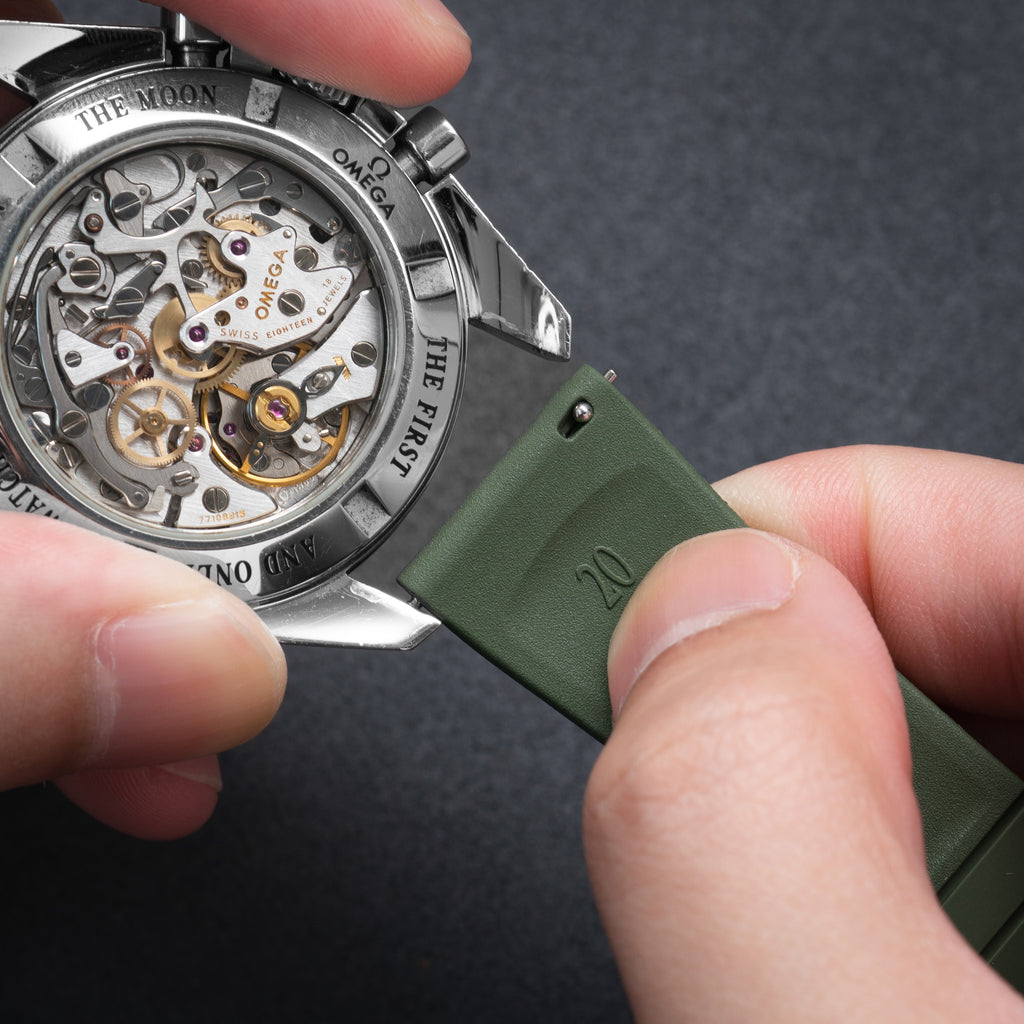
CTS straps attach to your watch like any other strap — by quick-release spring bars, or an integrated adapter where the watch demands it. It's the other end of the strap where the magic happens.
The tail of every CTS strap is a series of repeating segments: a cutting groove followed by spring bar holes. Cut along the groove, place the spring bar into the last available hole, and click it into the deployant clasp. That's the whole system.
We understand the trepidation of making a permanent cut to your new strap — that's exactly what this guide is for.
The clasp
The leaf-spring deployant clasp
The other half of the system. Designed to complement the CTS straps in both operation and look, the clasp flips open and shut via a leaf-spring mechanism with a satisfying tactile snap — no buttons, no pushers. Formed of 316L stainless steel, it holds its strength through relentless daily use, sea water and rain.
There are two versions: the classic CTS Deployant Clasp, and the Micro-Adjust CTS Deployant Clasp, which adds 6mm of tool-free fit adjustment (3mm per side) so you can fine-tune the fit for the season. Learn more about the Micro-Adjust clasp.

Watch the full video guide
The whole process, start to finish. Scroll on for the pictorial version you can follow along while cutting.
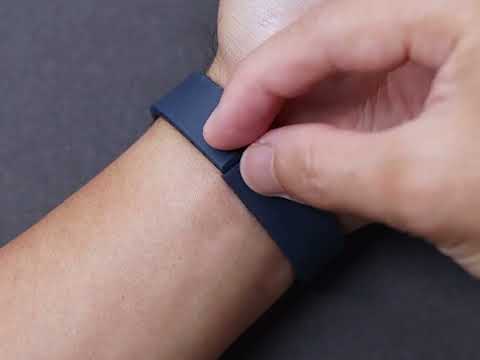
Before you begin
Lay everything out on a clean, soft surface. Here's what you're working with.

In the box
- Main strap body
- Quick-release spring bars
- Cut-to-size segments (the tail you'll trim)
- Deployant clasp

Tools you'll need
- A soft surface — a mousepad or a valet tray
- Scissors, or a box cutter with a cutting mat
- A thin tool to depress spring bars — a spring bar tool or a toothpick
- Your watch, with its existing strap removed
The guide
Three steps: Test, Cut, Check
Go slow on the first pass — you can always cut again, but you can't add rubber back.
Test
Install the strap on your watch — the quick-release spring bars make quick work of that. Place the watch face down on your soft surface, rest the top of your wrist against the case with your palm facing up, and gently pull the straps up and over your wrist so they overlap. Don't tug — your wrist shouldn't feel pulled at. This keeps the watch centred.
The clasp holds the two rubber ends close together, so the aim is to cut just enough that the clasp sits snugly — but not too tightly — at the centre of your wrist. Count the number of holes you need on each side, relative to the centre line of your wrist.


Cut
Make the initial cuts with your scissors or box cutter — and always cut along the groove. There's nothing more to it. If you're unsure, cut one segment at a time and re-test between cuts.

Check
Install the included spring bars into the last available hole on each side, then install the strap onto the clasp. Take care that the clasp faces the correct direction — towards your watch. The spring bar should drop in with a click. If your clasp has micro-adjustment positions, start with the hole furthest inside the clasp; you can fine-tune the fit afterwards.
Put the watch on and close the clasp — slowly, the first time, so you don't pinch yourself on the leaf spring. Then test the fit: shake your wrist, adjust the watch, flip your hand over and check the clasp sits centred.


Repeat until it's perfect
From here, just repeat the loop. If the clasp sits skewed to one side, cut the other side only — one segment at a time — until it sits snug and centred. That's all there is to it. Enjoy your new strap for the years to come.
Daily use
How to wear it
Different from run-of-the-mill button-actuated deployants, the leaf-spring clasp is secure by design — and putting it on takes two seconds:
- Pinch one side of the clasp closed;
- Pinch the other side closed as the curved base rests on your wrist.
Removal is even easier — pull upwards on either side and the deployant springs open.
Two mistakes to avoid
Each cut is permanent, so it pays to know what 'wrong' looks like. Both of these are avoidable by cutting conservatively, one segment at a time.

Overly tight
The clasp shows an excessive gap and the strap pulls on the wrist. This happens when too many segments are cut away — usually by cutting too far on the first try. Leave an extra segment on your first pass.

Clasp not centred
Cutting both sides to equal length in one go is the usual culprit. Wrists aren't symmetrical — most people need different lengths on each side, so test and trim one segment at a time.
Note: some people prefer a very snug fit — a slight gap between the two sides of the clasp is normal and doesn't affect the mechanism's security.
Sized at home by thousands
Rated 4.8/5 across 1,500+ rubber strap reviews. Here is how the cutting went for everyone else.
“From opening the package to putting it on my wrist took no more than 10 minutes. The instructions were very helpful and straightforward.”
“Initially I was a bit afraid of the fact of having to cut the strap and adjust it, but it looks insanely good. Very worth it.”
“The quality of the strap and clasp could not be better! It is a perfect fit, and the sizing was SOOO easy! Will definitely be back to get more straps in the future!”
“Cutting it to size is straightforward and the two micro-adjust positions on the clasp give you sufficient peace of mind during the warmer days.”
Frequently asked questions
What if I cut more than I should have?
Must I cut the same number of segments on both sides?
After cutting, can I adjust the strap for another watch?
This gets difficult if the lug-to-lug distance varies by a significant amount. For example, a Cartier Tank Large (19mm lug width) has a 33.7mm lug-to-lug distance, while a Grand Seiko SBGH267 with the same lug width measures 47.4mm — a disparity of 13.7mm (almost half an inch!) that would place the clasp in a very different position on your wrist. In that case, we'd recommend a second set.
Will you be releasing more colours in future?
Can I place a custom order using the same rubber?
Can I buy the clasp separately?
Will the clasp cause any issues for those of us with more arm hair?
How do I care for the rubber strap?
Can I wear the strap to swim?
What if my watch requires a larger diameter spring bar? (e.g. some Seiko divers)
Will the strap suffer from "case rub" on watches with short lug arms?
Can I use these straps with a watch that requires curved lugs?
How does the clasp work? Does it have any magnetic parts that may damage my watch?
Ready for effortless wear?
Precision-moulded FKM rubber, trimmed once for a fit no off-the-shelf strap can match. Swim-ready, easy to clean, and available in universal and watch-specific fits.
![Anthracite Hook Strap [kollokium x Delugs] - Image 2](http://delugs.com/cdn/shop/files/20250919-A7405309_298x298_crop_center.jpg?v=1761299094)
![Delugs Anthracite Hook Strap [kollokium x Delugs] Fabric Watch Strap](http://delugs.com/cdn/shop/files/Kollokium_straps_Anthracite_1_298x298_crop_center.jpg?v=1761299094)